CIDIR設立時のミッション Mission
総合防災情報研究センター(CIDIR)は、東京大学大学院情報学環、地震研究所、生産技術研究所3部局の連携により、平成20年4月1日に設立されました。「情報」を核に「減災」をめざす、これがCIDIRに課せられたミッションです。
気候変動の影響による巨大台風の発生増加や、地震活動期への移行の可能性が懸念されています。予想される大規模な自然災害による被害を軽減するうえで、災害危険度の評価や予測とその周知、災害からの避難、応急対策の調整、復旧・復興における合意形成など、防災・減災のすべての段階で、「情報」が果たす役割はますます高まってきています。
しかし、「情報」を核に「減災」をめざすには、予知・予測から、災害軽減技術、情報受容プロセスまで、すべての叡智を集め、協働することが求められます。
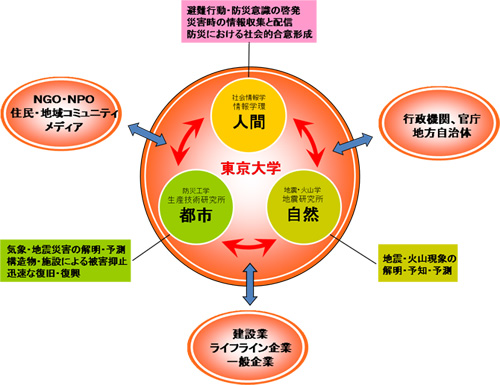
CIDIRは、まさに情報の概念を核とした文理融合型の総合的な防災研究機関として誕生しました。防災・減災における知の結節点として機能する新しいタイプの研究機関を目指し、次の3つの連携による研究を進め、課されたミッションを果たしていきます。
- 社会情報学、地震火山学、防災工学の分野を超えた協働による総合的防災情報研究の推進
- 理学、工学、法学、経済学、医学など様々な防災関係分野の研究者ネットワークの構築
- 行政、マスコミ、企業、NPOなど社会との連携と情報発信
1. 災害情報の生産-伝達-受容過程の解明
緊急地震速報、予警報、避難勧告・指示、ハザードマップなど災害情報の生産から伝達、受容に至る全過程を解明し、その科学的知見に基づく適切な災害情報のあり方を探求しています。
2. 首都直下地震災害の全体像の把握
危惧される首都直下地震を対象に、物的被害から経済的影響、社会的影響へと研究を拡大し、首都直下地震の被害の全体像を科学的に探求しています。未開拓の研究課題や社会的課題を発掘し、減災に貢献します。
3. 大学SCM(Service Continuity Management)モデルの開発
将来を担う学生や研究者など大学の人的資源を守り、災害後も大学の社会的使命を果たし続けるための大学サービス継続マネージメントモデルを、大学本部と連携しつつ開発し、情報発信していきます。
4. 防災制度の設計と運用に関する研究
地震災害・風水害・火山災害などを対象に、事前の被害抑止や軽減策、発災後の円滑な応急対策、復旧・復興すべてのステージを俯瞰した防災制度の設計と運用に関する研究を進め、社会に提言しています。
5. 災害情報教育の実施とプログラム開発
大学院学際情報学府の教育課程に総合防災情報の専門家養成に向けた『災害情報論』を平成21年度から開講し、将来的には全学横断型科目への展開を目指します。社会との連携のひとつとしてライフライン・マスコミ連携講座を開催しています。
Mission at the Founding of CIDIR
The Center for Integrated Disaster Information Research (CIDIR) was established on April 1, 2008, through collaboration among three divisions of the University of Tokyo: the Interfaculty Initiative in Information Studies, the Earthquake Research Institute, and the Institute of Industrial Science. CIDIR’s mission is to reduce disaster risk through the strategic use of information at the heart of its activities.
Concerns are growing over the increasing frequency of large typhoons driven by climate change, as well as the possibility of entering an active seismic period. In order to mitigate the damage from potential large-scale natural disasters, information now plays an ever more critical role at every stage of disaster management: from hazard assessment, forecasting, and public communication, to evacuation, coordination of emergency response, and consensus-building in recovery and reconstruction.
Achieving information-centered disaster risk reduction requires the integration of all knowledge and wisdom and the collaboration across all disciplines at every aspect of disaster management, such as prediction, forecasting, disaster damage reduction technologies, and information perception.
CIDIR was founded as a comprehensive, interdisciplinary disaster research institute, with information at its core as the guiding concept for reducing disaster risks. It aims to serve as a new type of research institute—one that functions as a knowledge hub for disaster management—and is committed to fulfilling its mission through three forms of collaboration:
- Promoting integrated disaster information research through cooperation across disciplines, such as social informatics, seismology and volcanology, and disaster engineering
- Building research networks that connect diverse disciplines related to disaster studies, including science, engineering, law, economics, and medicine
- Strengthening partnerships and information-sharing with key stakeholders in society, such as government, media, business, and non-profit sectors
1.Understanding the production, transmission, and reception of disaster information
We examine the entire process of disaster information—from its creation to its transmission and eventual reception—covering elements such as earthquake early warnings, alerts and advisories, evacuation recommendations and orders, and hazard maps. Drawing on the scientific insights gained from these studies, we explore how disaster information can be designed and communicated most effectively.
2.Understanding the overall impact of the Tokyo metropolitan earthquake
Focusing on the Tokyo metropolitan earthquake—a seismic event expected to occur directly beneath Japan’s capital—we extend our research beyond physical damage to include economic and social impacts, seeking to build a comprehensive scientific understanding of its potential consequences for the metropolitan area. By identifying unexplored research topics and emerging social challenges, we aim to contribute to effective disaster risk reduction.
3.Developing a university service continuity management (SCM) model
In collaboration with the university administration, we are developing a service continuity management model to safeguard students, researchers, and other members of the university community—human resources who will play vital roles in society’s future—and to ensure that the university can continue fulfilling its social mission even after a disaster. We also share the knowledge gained through this work with society.
4.Research on the design and operation of disaster management systems
We conduct research on the design and operation of disaster management systems that address seismic, volcanic, and storm‑related hazards, taking a comprehensive view of all stages—from pre‑disaster prevention and mitigation measures to efficient, effective emergency response, and through to post‑disaster recovery and reconstruction. Drawing on this research, we provide society with practical recommendations to help achieve more effective disaster management.
5.Developing and implementing disaster information education programs
Since 2009, we have offered the course Disaster Information Studies in the curriculum of the Graduate School of Interdisciplinary Information Studies to train specialists in comprehensive disaster information. Looking ahead, we aim to expand it into a university‑wide interdisciplinary subject. As part of our collaboration with society, we also organize a joint lecture series with lifeline industries and the mass media.